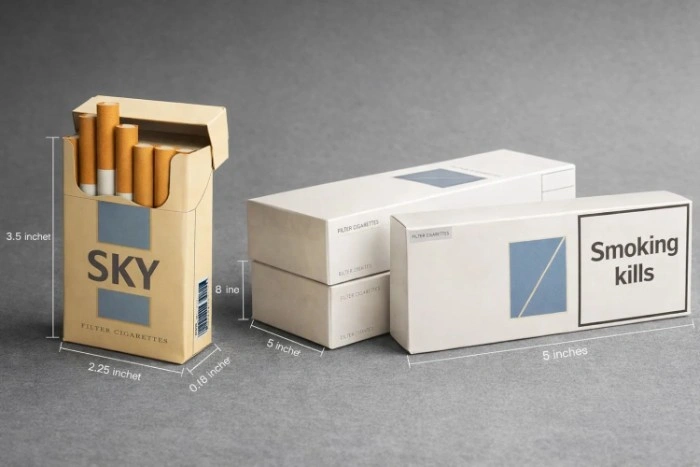
Understanding how many cigarettes are in a pack may sound simple, but there is actually an organized and precise global approach to cigarette packaging. Irrespective of whether the cigarette pack is being sold as a retailer item or sent abroad, the dimensions of the cigarette pack can be easily identified.
This article aims to offer an overview on how cigarette packs are dimensioned, carton types, global variations, and cigarette packaging in general terms for easy comprehension.
What Is a Cigarette Pack?
| Pack Type | Number of Cigarettes | Availability | Notes |
|---|---|---|---|
| Small Pack | 10 | Limited / Restricted | Budget option, banned in some countries |
| Standard Pack | 20 | Global Standard | Most common worldwide |
| Large Pack | 25 | Canada, Australia | Slightly higher value packs |
| Value Pack | 30 | Select markets | Promotional / bulk option |
The cigarette pack can be defined as the smallest unit in which the cigarettes are sold. Every time one wonders about the quantity of cigarettes in a cigarette pack, all he/she wishes to know is the smallest unit available in the market.
The standard cigarette boxes in most countries consists of:
- 20 cigarettes in one pack
It is the standard value which is accepted for all major cigarette brands around the globe.
Why Are There 20 Cigarettes in a Pack?
| Packaging Level | Quantity | Total Cigarettes |
|---|---|---|
| 1 Pack | 20 | 20 |
| 1 Carton | 10 Packs | 200 |
| Bulk Variants | 15–20 Packs | 300–400 |
The choice of twenty cigarettes in one pack was never accidental. There were a number of factors behind that.
1. Consumer usage patterns
Firstly, consumer habits played a huge role since, traditionally, many smokers used one whole package a day. The number twenty matched these consumption habits perfectly.
2. Tax system simplicity
Secondly, it became easy for governments to tax their sales because packages contained the same amount of cigarettes.
3. Manufacturing efficiency
Thirdly, manufacturing facilities make millions of cigarette packages daily, and a certain number of cigarettes helps to accelerate this process.
4. Retail pricing consistency
Fourthly, the issue of pricing becomes clearer when packages have an identical number of items.
Are All Cigarette Packs the Same Size?
The packages of cigarettes might appear to be almost identical, their sizes may not be uniform across the globe. The sizes of packs of cigarettes differ according to regulations in individual countries and the branding strategy employed by companies.
Due to public health measures in many nations, cigarette sales are regulated by the government. These guidelines determine the number and size of cigarette packs.
Here are some cigarette pack sizes that are available globally:
- 10 cigarettes per pack
These packs are smaller to cater to smokers who are looking for affordable options. Some nations, however, have imposed restrictions on these packs, to eliminate smoking.
- 20 cigarettes per pack (Standard Size)
This type of cigarette pack is most commonly used. In terms of global use, it is also considered the standard pack because of its convenience and price point of view.
- 25 cigarettes per pack
This type of cigarette pack is usually found in places like Canada and Australia
- 30 cigarettes per pack
These are less common and are found in selective markets as value packs or promotional options for their people.
How Many Cigarettes in a Carton?
Cartons are larger packaging units, primarily meant for use in wholesale shipment and stock.
For those who would like to know how many cigarettes are in a carton, the answer is:
- 200 cigarettes per carton
This is derived from the most prevalent packaging system:
- 1 carton contains 10 packs
- 1 pack contains 20 cigarettes
10 x 20 = 200 cigarettes
This value is most globally accepted standard for cigarette packing in a carton.
How Many Cigarette Packs in a Carton?
People also search for how many cigarette packs are in a carton of cigarettes or how many packets of cigarettes are in a carton.
The general answer to that is:
- 10 packets in a carton
There are other variations which can be as follows:
- 15 packets in a carton
- 20 packets in a carton
But for most of the countries worldwide, 10 packets in a carton is the standard system.
Cigarette Carton Box Size Explained
The cigarette carton box size in which the cigarettes are packed is not standard throughout the world because it varies depending on:
- Number of packets contained within the cigarette carton
- Length of the cigarette packet (either regular, 85mm, king size, 100mm, etc.)
- Thickness of packaging material
- Branding and printing requirements
- Regulatory warning label space
General characteristics of carton packaging:
- Rigid rectangular box
- Stackable inside shipping containers
- Built to withstand damage when transporting packages
- Features branding and health warnings printed on the box
- The design of the carton is carefully planned during production to minimize waste and optimize shipping.
Types of Cigarette Packs
| Pack Type | Material | Protection Level | Popularity | Key Feature |
|---|---|---|---|---|
| Hard Pack | Rigid Cardboard | High | Very High | Durable & premium |
| Soft Pack | Thin Paper | Low | Medium | Flexible & classic |
| Slim Pack | Cardboard | Medium | Growing | Elegant & narrow |
| 100s Pack | Cardboard | High | Moderate | Longer cigarettes |
When discussing cigarette sizes, we are not just talking about numbers but also physical design.
1. Hard packs
Hard packs are the most commonly found cigarette pack type on a global scale. They are created using rigid cardboard, usually having a lid that flips up and down.
- Protect cigarettes from any kind of crushing or other damage
- Keep cigarettes fresh and maintain their shape for a long period of time
- Usually belong to high-end or regular products
- Convenient to carry in one’s pocket or bag
Due to their quality and attractive appearance, hard packs have become a worldwide industry standard.
2. Soft packs
Soft packs consist of thin papers or laminated materials without a hard casing. Though their usage was prevalent earlier, soft packs continue to be used in some regions even today.
They are:
- Flexible
- Easily foldable and compressible
- Lack protection, causing cigarettes to break or bend
- Often attract people who favor classic designs
- The top portion of soft packs is easy to tear and does not seal well like hard packs.
3. Slim packs
Slim cigarette packages are manufactured to cater to slimmer cigarettes, and even their designs match their slim structure.
- Narrow, compact, and elegant design
- Typically presented as premium products
- Simple to carry because they are narrower
- Preferred by cigarette manufacturers to convey a sense of elegance through their products
These cigarette packages are extremely common in regions where aesthetics are very important.
4. 100s packs
“100s” packages are cigarettes that are larger compared to king-size cigarettes and are mostly about 100mm in length.
- Package size is taller due to larger cigarette sizes.
- The number of cigarettes per package remains unchanged at 20 cigarettes.
- They are seen as giving more smoking time.
- These can be packaged either as hard packages or soft packages.
Why Cigarette Packaging Standardization Matters
There are a number of reasons why standardization of cigarette package contents is vital:
1. Logistic purposes
Standardized packaging makes transport and storage easier.
2. Financial considerations
It allows better estimation of material consumption by manufacturers.
3. Convenience purposes
It simplifies retail operations.
4. Legal regulations
It is necessary to implement legal requirements on packaging.
For packaging companies like Packaging Heights, these standards directly influence box design, structural strength, and branding layout.
Global Differences in Cigarette Packaging
Though there is a standard, each country may differ because of their policies and consumption habits.
While some allow smaller packs (10 sticks), other countries allow packs containing larger numbers (25-30) for price manipulation purposes.
Other nations ban all forms of cigarette packaging due to plain packaging legislation.
The effect of such policies is that they determine the number of cigarettes contained in a pack.
FAQs
How many cigarettes are there in a pack of cigarettes?
The usual number of cigarettes that fit into a pack is 20.
How many packs of cigarettes make up one carton?
There are 10 packs in one carton.
How many cigs in a carton?
A carton can contain 200 cigarettes.
Are all countries alike in terms of the number of cigarettes in a pack?
No, the number varies from 10 to 30.
Final Thoughts
Knowing the number of cigarettes per pack and the number of cigarette packs per carton can assist us in understanding global packaging processes. The above facts are not arbitrary; they have been developed through years of experience of manufacturing process and consumer behavior.
For sectors such as packaging, retail, and logistics, knowledge about such measurements is critical to developing effective and efficient packaging.








 Company
 Top products
 Help
Help
 Payment Method