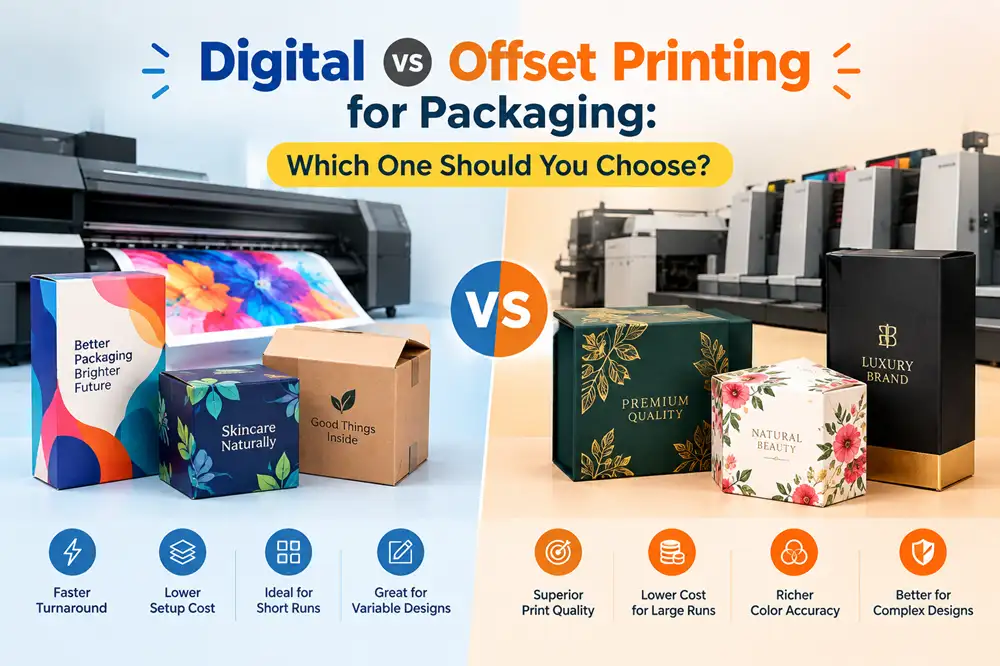
Selecting a proper way of printing on custom packaging can influence almost all aspects of the ordering process, including color reproduction, degree of personalization, time needed, and even price. There are two popular options – digital and offset printing – that both have their own benefits depending on the nature of the packaging project you are going to create.
But how to select one of the two?
There are many things to consider, among which your order volume, design complexity, budget, time constraints, and the extent of your personalization needs. When it comes to digital vs. offset printing, it is not just about selecting better technology. It is more about choosing a method that suits your packaging purposes.
In this blog, we will discuss how digital and offset printing differ and what is better for packaging your boxes.
What Is Digital Printing for Packaging?
Digital printing is a contemporary printing technology that involves direct transfer of a digital artwork file onto the printing surface. As opposed to traditional offset printing technology, custom printing plates are not required.
It may be viewed as something similar to a professional-grade commercial printer, though built specifically for the purposes of custom packaging production.
Your artwork is created digitally and then printed onto the printing machinery without the need for a middleman. This makes digital printing ideal when there is a necessity to print boxes in small runs, prototyping, seasonal packaging, personalized boxes, etc.
Custom packaging options that may be printed through digital printing include:
- Product boxes
- Retail packaging
- Food packaging
- Cosmetic boxes
- Subscription boxes
- Promotional packaging
- Small batch packaging
- Personalized packaging
The greatest advantage of this printing technology is flexibility. It allows one to easily print several designs in one and the same order.
What Is Offset Printing for Packaging?
Offset printing is an old printing technique that involves transferring ink to a substrate using the printing plates in the form of an intermediate cylinder.
Instead of printing the design directly from the digital file to the packaging material, the design is transferred in different steps in the process of printing. It takes longer to set up, but offset printing can yield very consistent results on a large scale.
Offset printing is often done for large packaging jobs because the upfront cost of setting up may become more economical when applied to a larger number of boxes.
It is often used for:
- Bulk packaging
- Product-branded boxes
- Cosmetics packaging
- Food packaging
- Pharmaceutical packaging
- Luxury packaging
- Promotional bulk packaging
Offset printing is particularly helpful when there is a need to maintain consistent coloration for thousands of boxes.
Digital vs Offset Printing: What Is the Difference?
The largest difference here is how the artwork is transferred onto the packaging material.
In the case of digital printing, the art is done using a digital file, while in offset printing, the art is done using printing plates.
This difference impacts cost, turnaround time, personalization, and best order quantities.
|
Factor |
Digital Printing | Offset Printing |
|
Setup |
Minimal | More extensive |
|
Best for |
Short to medium runs |
Medium to large runs |
|
Customization |
Very flexible |
Better for standardized designs |
|
Variable designs |
Easier |
More complicated |
|
Small orders |
Cost-effective |
Higher setup impact |
|
Large orders |
Can become less economical |
Often more economical |
|
Color consistency |
Very good |
Excellent for large runs |
|
Turnaround |
Generally faster to start |
Longer setup |
|
Prototypes |
Excellent |
Usually less practical |
Digital vs Offset Printing for Small Orders
When you order a relatively low number of boxes, digital printing becomes a viable solution. Offset printing incurs setup costs in the form of plate production and setting up the press. In case you require only a few hundred boxes, these setup costs will account for a sizable chunk of your overall cost.
In this case, the absence of plate setup becomes helpful in digital printing.
For instance, let us consider a skincare product that needs 300 product boxes for launch. It is still trying out the packaging design, and the artwork can change based on feedback from the customers.
Digital printing makes it possible to print a small number of boxes without going for a huge order.
This makes digital printing highly beneficial for the following cases:
- New startups
- Product launches
- Limited edition products
- Seasonal collections
- Market research
- Prototype packaging
When Does Offset Printing Make More Sense?
It is more and more appealing to go for offset printing as orders increase in volume.
While offset printing involves more setup, per-unit cost may be less for higher volumes. When your demand is for thousands or even tens of thousands of identical boxes, then it makes sense to consider offset printing because the cost of setup would then be shared throughout.
An example is an established cosmetics company that manufactures one popular product in the country.
In such a case, offset printing may be appropriate for the task.
Offset printing should be considered if:
- You have large order volumes
- The packaging will not change
- Color accuracy matters
- There will be repeat orders
Which Printing Method Offers Better Color Quality?
Color accuracy is among the most prevalent factors considered when evaluating digital and offset printing technologies.
Both technologies are able to provide good quality packaging, but the methods of color reproduction are different.
In particular, offset printing is especially good at reproducing colors precisely. The technology can also make use of certain specific colors, including Pantone colors, when branding consistency is an essential factor.
This can come in handy for already well-established brands with very rigid packaging standards.
At the same time, digital printing is able to print vibrant and high-resolution graphics without all the preparation involved in the case of offset printing.
Modern digital printers are also advanced enough to make digital printing suitable for premium packaging products.
Thus, the best choice depends on the specifics of the artwork, material, colors, and other aspects of the production process.
Digital Printing Is Better for Variable Designs
One of the best features of digital printing is the capability to switch the art around from one box to another.
For instance, a snack manufacturer could come up with various designs for their snack packs depending on the flavor, without having to establish a new traditional printing system for each one.
Digital printing can also facilitate the following:
- Personalized design
- Varied brand names
- Different graphics
- Special edition artworks
- Regional pack design
- Promotional campaign
- Sequence design
Offset printing is more appropriate for large batches of uniform art.
Which Is Faster: Digital or Offset Printing?
Generally, digital printing is faster when moving from approved artwork to printing since there is no physical setup required.
The offset printing process involves more steps before printing takes place, such as creating plates and setting up the press.
Nevertheless, the term “faster” does not imply that the whole printing process will always be quicker with the use of digital printing technology. Finishing, cutting, gluing, material acquisition, and shipping can play their roles here too.
If a small quantity is required urgently, digital printing will come in handy.
With large repeated print orders, extra steps related to offset setup might not matter much in comparison with the entire order volume.
Digital vs Offset Printing: What About Cost?
Cost is another point where it really matters. Digital printing tends to have less initial investment needs which makes it a good choice for short run orders. Though when quantities rise it could become more costly on a per unit basis.
Offset printing always includes greater initial investment needs, but those costs will be spread out to many more pieces during large-scale production.
The simplified idea is:
Small quantity + frequent changes = Digital could be preferable
Large quantity + constant design = Offset could be preferable
However, the cost of your package cannot be calculated based on printing alone.
Final cost depends on such factors as:
- Box dimensions
- Package material
- Thickness of board
- Print area
- Number of colors
- Options for finishing
- Inserts
- Design structure
- Quantity of order
- Shipment details
That is why comparing total package quotations would be much better than just comparing printing techniques.
How to Choose Between Digital and Offset Printing
There isn’t just one solution to the question of which printing process you should use. Begin by considering five practical factors.
1. Consider Your Order Size
Digital printing could work for smaller orders, while large, standard orders could justify the use of offset printing.
2. Consider Your Design
When the artwork for each box is the same, then offset printing may be appropriate for a high-volume order. When you have a different design or varied information, then you will need digital printing.
3. Consider Your Color Needs
If color accuracy is necessary for your brand, speak to your packaging manufacturer regarding their requirements.
4. Consider Your Time Frame
When you need a quick production cycle for a small order, digital printing may take care of any time saved on the setup phase of conventional printing.
5. Consider the Full Quote
Don’t consider prices for printing alone. Find out about the full cost of manufacturing your packaging, including printing and assembly costs.
Digital vs Offset Printing: Which One Should You Choose?
It all comes down to what you need for your packaging project.
Digital printing may be the better solution if you are looking for small runs, fast set-up, prototypes, personalized graphics, or changing artwork.
Offset printing would be the logical route if you are looking for large runs, consistency in your artwork, color control, and cost-effective solutions.
Some businesses may even find that their decision may change based on the development of their business. Start-ups may initially use digital printing to get boxes printed while developing their products and then use offset printing as orders grow.
The best solution is to take everything into account.
Make the Right Printing Choice for Your Packaging
It is quite easy to decide which one of them should be used if you are aware of the needs of your packaging. Rather than concentrating solely on the printing process, look at the bigger picture and think about quantity, design, color, timing, finishing, and the overall cost of production.
Whether you are producing your packaging for the first time in a small quantity or developing your existing packaging on a large scale, selecting the appropriate printing process may do wonders for you.
Need help deciding between digital and offset printing for your custom boxes? Contact Packaging Heights to discuss your packaging requirements and get a solution tailored to your order.
FAQs
Is digital printing cheaper than offset printing?
Digital printing could be cheaper in case of small quantities since the start-up costs would be reduced. In case of big production, offset printing would be cheaper since the start-up costs would be shared.
Is offset printing better for packaging?
Offset printing could be really good for packaging in case of big productions when accurate reproduction of art and colors is required. In other cases, digital printing would suit better.
Can digital printing be used for premium packaging?
Yes. Digital printing can be used for professional packaging, and different coatings can be applied depending on the material used.
Which printing method is better for custom packaging?
Any could be used for custom packaging. Digital printing is flexible for small productions, and offset printing is used mainly for standardized large packages.
Can I get a packaging prototype before placing a large order?
Yes. This will allow you to check out your package in terms of its design, size, color, and so on.


 Company
 Top products
 Help
 Payment Method
