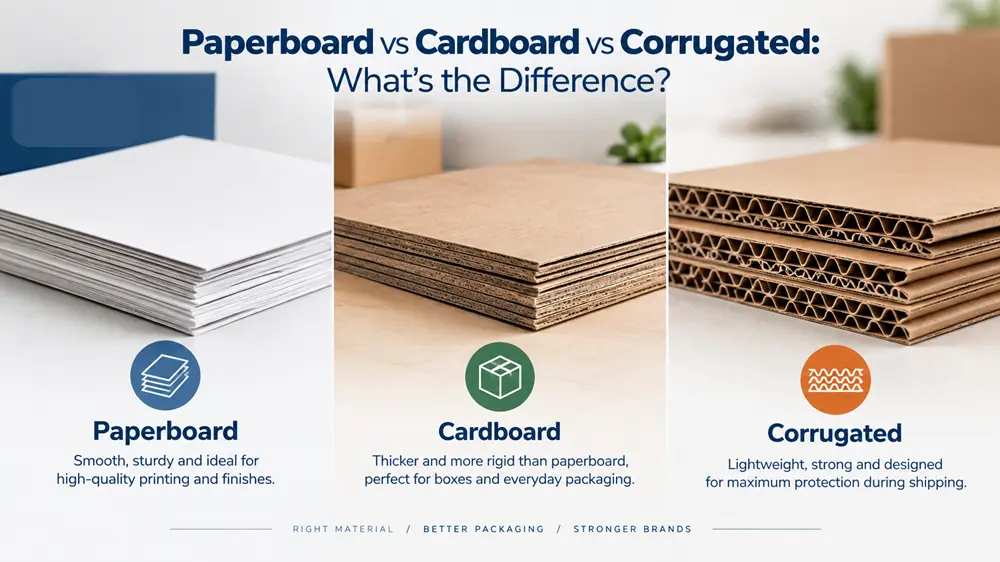
The words paperboard, cardboard, and corrugated may be applied interchangeably when referring to different types of packaging materials. However, this is not always true. The construction, thickness, durability, printability, and other features of such materials may vary a lot.
It is important to be aware of the differences between these types of materials to select proper packaging for protection of your product and at the same time for brand presentation and other purposes.
In general, paperboard is a thick sheet of paper that is widely used for retail cartons; corrugated board consists of paper with the added strength provided by flutes; and cardboard refers to several types of paper-based boards.
Thus, which material should you select for your product?
That depends on what your packaging needs to accomplish.
Paperboard vs Cardboard vs Corrugated at a Glance
|
Feature |
Paperboard | Cardboard | Corrugated |
|
Structure |
Solid paper-based board | General/catch-all term | Fluted layer between liners |
|
Strength |
Light to moderate | Varies | High |
|
Surface |
Smooth | Varies |
Usually textured |
|
Printability |
Excellent | Depends on material |
Good |
|
Folding |
Excellent | Varies |
More structural |
|
Cushioning |
Limited | Varies |
Excellent |
|
Common use |
Retail packaging | General packaging term |
Shipping boxes |
| Best for | Branding and presentation | Depends on board type |
Protection and transportation |
The most notable distinction is the construction. The paperboard is usually a solid piece or multi-layer board, whereas the corrugated fiberboard consists of flat linerboards along with a fluted inner layer. The term “cardboard” refers to either of them.
What Is Paperboard?
Paperboard refers to a thick paper-like substance made up of cellulose fibers. Unlike normal paper, paperboard is usually thicker and more rigid, making it more appropriate for packaging applications.
Paperboard is made using either new, used, or a mixture of both fiber types based on the type and manufacturing process involved. Properties include thickness, rigidity, density, finish, and printability.
Unlike corrugated board, paperboard does not have a fluted core. It is therefore ideal for packaging where a clean and elegant appearance is required.
Common Paperboard Packaging Uses
Paperboard is widely used for:
- Cosmetic boxes
- Cereal cartons
- Pharmaceutical boxes
- Food packaging
- Folding cartons
- Soap boxes
- Tea boxes
- Retail product boxes
- Small electronics packaging
- Printed sleeves and cartons
The smooth surface of the board also makes it ideal for graphics and finishing applications.
Brands can avail themselves of special printing, embossing, debossing, foil stamping, coatings, and other finishes. This is one reason why paperboard is such a common choice for products that rely on their box being part of the consumer’s experience.
What Is Cardboard?
This is where things start to get a bit complicated. “Cardboard” is a generic name rather than an actual packaging term. It is widely used to refer to any packaging that consists of thick papers, such as paperboard and corrugated.
So, one person may refer to a cereal box as a cardboard box. Another person can refer to a shipping box made out of corrugated fiberboard as a cardboard box.
These types of packaging are actually quite different.
Which is why companies ordering custom packaging should not use the term “cardboard.” Instead, it is better to use terms like “paperboard,” “solid board,” or “corrugated fiberboard.”
Why “Cardboard” Can Be Misleading
Think about telling a packaging company that you need “cardboard boxes.”
They might need to know things like:
- Do you want a folding carton?
- Will the box go on a retail shelf?
- Will it need to withstand shipping?
- How heavy will the item be?
- Should the box have a gloss or matte finish on its printed surface?
- Should there be cushioning involved?
- Should there be stacking involved?
- Do you need high-end finishing?
These factors will dictate whether paperboard or corrugated packaging would be better.
In other words, when thinking about the difference between paperboard vs cardboard vs corrugated, remember that cardboard is usually a more general term than paperboard and corrugated.
What Is Corrugated Board?
Corrugated board or corrugated fiberboard refers to an engineered paper-based packaging material that uses a fluted core material with one or two flat sheets of linerboard.
Single-wall corrugated board usually comprises the following layers:
Outer liner + fluted medium + inner liner
Fluted material forms small arches between outer and inner liners. This design provides corrugated board with unique properties of stiffness, strength, and cushioning while not needing the entire material package to consist of a solid thick layer. That is why corrugated packages are usually employed when protection of items during transportation is needed.
Common Corrugated Packaging Uses
Uses of corrugated board include:
- Shipping boxes
- E-commerce packaging
- Mailer boxes
- Moving boxes
- Subscription boxes
- Product shippers
- Cartons for distribution
- Industrial packaging
- Protective inserts
- Heavy-duty packaging
If your product has to go through a courier service or distribution channel, you can consider packaging your product in a corrugated package.
Paperboard vs Corrugated: What Is the Main Difference?
The main distinction between paperboard and corrugated board is that of their construction.
Paperboard is typically a single piece of board material, whereas corrugated board consists of a medium between two liner boards.
The distinction in construction impacts practically everything else.
1. Strength
Corrugated board is manufactured for its structure. The flutes of corrugated board give it stiffness, cushioning, and strength against compression.
Paperboard is usually lighter and not made for harsh shipping requirements. This does not imply that paperboard is structurally weak in any way; it just has a different function.
For instance, a cosmetic box does not necessarily require structural integrity to the extent of being shipped across the country in a distribution channel.
2. Print Quality
Most paperboards offer smooth surfaces for more graphic-intensive and high-quality prints.
This is why they are often ideal for use in retail packaging where the typography, photos, logo, colors, and other information needs to be very clear. Corrugated packaging can also be printed; however, because of its structure and surface, they are better designed for shipping graphics and other simple graphics.
3. Product Protection
One of the significant advantages that corrugated packaging has over other materials is its ability to protect items when shipped. The fluted liner gives room for the board to cushion against impact and compression.
For packages where the primary use is containment, presentation, and packaging of the product, paperboard will be more suited.
4. Appearance
Paperboard tends to offer a neat, clean look that is suitable for high-end brands.
Corrugated containers tend to have a more utilitarian look, but with modern printing techniques, they can be made quite visually appealing.
Brands that concentrate on aesthetics and luxury packaging would benefit from paperboard’s capabilities.
Brands concentrating on shipping and ecommerce would prefer corrugated containers.
Paperboard vs Cardboard vs Corrugated: Which Is Stronger?
There is no straight answer, since “cardboard” refers to several types of paperboard.
If you compare regular paperboard with corrugated fiberboard, the latter is structurally stronger and more cushioning due to its fluted structure.
The performance of the corrugated board will depend on its specific construction, which can be tailored according to needs.
Some of the factors that might be considered by packaging engineers include:
- Type of flute
- Thickness of the board
- Number of walls
- Edge crush resistance
- Burst resistance
- Weight of the product
- Dimensions of the box
- Transportation conditions
Hence, do not judge a box by its thickness alone.
Paperboard vs Corrugated for Shipping
Shipping creates another challenge. The shipment that starts at a fulfillment center, travels to the delivery vehicle, the warehouse, and to the customer’s door can be exposed to compression, impact, vibration, stacking, and handling.
Corrugated packaging comes into play here. Corrugated boards are created with structural performance in mind, and the structure itself gives the boards strength without needing a solid and dense material.
For e-commerce, shipping cartons, subscription boxes, and mailer boxes, corrugated packaging is a solution that works.
In some instances, companies use both materials together – paperboard printed cartons with a product inside and a corrugated outer box for shipping protection.
Paperboard vs Cardboard vs Corrugated: Cost Differences
Cost varies according to several variables; thus, there is no standard cost differential for these materials.
Some variables that affect packaging cost include:
- Grade of material used
- Thickness of material used
- Size of box
- Quantity of order
- Printing technique
- Color used
- Die-cutting
- Finishing
- Coating
- Inserts
- Design
- Handling
An inexpensive paperboard folding carton may prove cost-effective in case of a light-weight consumer item, whereas a corrugated box is worth its extra material cost owing to better protection during transit.
Can Paperboard and Corrugated Be Used Together?
Yes. Indeed, using a combination of various types of packaging material can provide a balance between appearance and protection.
For instance, a company can use a paperboard box for the premium product and then put the paperboard box in a corrugated box.
This will provide two layers of packaging serving different purposes:
Paperboard – for branding and product presentation purposes.
Corrugated – for the purpose of protection during shipment.
Such a combination is especially important for e-commerce companies that wish to ship their products to customers safely but in an attractive way.
How to Choose the Right Packaging Material
Instead of asking only, “Which material is best?” start with the product and its packaging requirements.
Choose Paperboard When:
- Your product is not heavy.
- Product display matters.
- Graphics must be of high quality.
- A high-quality finish is needed.
- Efficient folding is essential.
- It is being used for retail packaging.
Consider Corrugated When:
- The product requires better protection while shipping.
- The packing will be stacked up.
- Products are either heavy or delicate.
- You conduct most of your sales online.
- The box will go through the distribution channel.
- Cushioning and strength matter.
“Cardboard” Is a Generic Term
In case you are told to make “cardboard box,” find out what exactly the person needs.
Is he asking for:
Folding carton from paperboard?
Shipping box made of corrugated material?
Box from rigid/solid board?
Clarifying the material upfront will help to avoid mistakes in costing, production, printing, and performance.
Final Thoughts
The distinction between paperboard vs cardboard vs corrugated goes beyond semantics. Choosing one of these materials can impact how well the package will protect your product, look, print, ship, and perform.
Paperboard gives a smooth surface for designing beautiful retail packaging. Corrugated board gives structure to products that require protection when transported. Finally, cardboard stays a generic term for several paper packaging types.
When a company designs custom packaging, the best strategy would be to start by identifying the functions of the box. After finding out the weight, environmental conditions of shipping, and branding needs of the product, choosing the packaging board is quite simple.
FAQs
- What is the difference between paperboard, cardboard, and corrugated?
Paperboard is a smooth, firm board material that is mostly used in retail packages. Corrugated board is made from an additional inner layer of fluting to make the material stronger. Cardboard is a common name for different paper packaging materials. - Is paperboard stronger than cardboard?
Paperboard is a strong and rigid material for light products, but for packaging and shipment, corrugated board will be stronger. Cardboard can consist of several kinds of paperboard, which means that the strength of cardboard can vary. - Is corrugated better than paperboard for shipping?
Yes, corrugated is always the right choice since the fluting gives more cushioning, compression, and protection. - Is paperboard good for product packaging?
Yes. Paperboard is commonly used in the packaging industry for products due to its printing properties, foldability, light weight, and branding purposes. - Which packaging material should I choose?
Use paperboard in cases where lightweight and retail presentation are important for the packaging, and use corrugated material in cases where transportation is involved or extra protection is needed.



 Company
 Top products
 Help
Help
 Payment Method