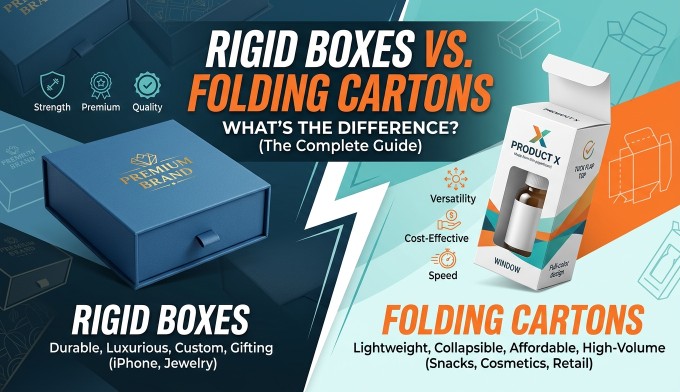
When choosing packaging for a product, the box is more than a container. It affects product protection, shipping costs, shelf appeal, brand perception, and the customer’s unboxing experience. Two of the most common options are rigid boxes and folding cartons.
At first glance, they may seem similar. Both can be custom printed, branded, finished with premium details, and designed around a specific product. The real difference lies in how they are constructed and how they perform.
Rigid boxes are thick, sturdy, and permanently formed, making them ideal for premium products and memorable unboxing experiences. Folding cartons are lightweight, foldable, and space-efficient, making them a practical choice for retail products and high-volume packaging.
So, which one is right for your brand?
Let’s compare rigid boxes vs folding cartons across structure, cost, durability, printing, storage, shipping, sustainability, and applications.
Rigid Boxes vs Folding Cartons: At a Glance
|
Feature |
Rigid Boxes |
Folding Cartons |
|
Construction |
Thick board wrapped with paper |
Single sheet of paperboard |
|
Structure |
Permanently assembled |
Folded and glued |
|
Shipping |
Usually shipped assembled |
Ships flat |
|
Durability |
Excellent |
Good to very good |
|
Premium feel |
Excellent |
Good to excellent |
|
Storage efficiency |
Lower |
Higher |
|
Unit cost |
Generally higher |
Generally lower |
|
Customization |
Extensive |
Extensive |
|
Best for |
Luxury, gifts, premium products | Retail, cosmetics, food, FMCG |
| Unboxing experience | High-impact |
Practical and attractive |
| High-volume production | Suitable |
Highly efficient |
What Are Rigid Boxes?
Rigid boxes, also called setup boxes, are made from thick paperboard or greyboard that is wrapped with printed paper, specialty stock, or other decorative materials. Unlike folding cartons, they are assembled before reaching the packing stage and maintain their shape.
Their substantial construction gives them a sturdy feel that immediately communicates quality. This is why rigid packaging is commonly used for products where presentation and perceived value matter as much as protection.
Common rigid box styles include:
- Magnetic closure boxes
- Two-piece rigid boxes
- Drawer boxes
- Book-style boxes
- Shoulder-neck boxes
- Hinged lid boxes
- Premium gift boxes
Rigid boxes are particularly popular for perfumes, jewelry, watches, luxury cosmetics, electronics, candles, corporate gifts, and premium gift sets.
The biggest advantage is the experience they create. A rigid box can make opening a product feel like opening a gift rather than simply unpacking an item.
What Are Folding Cartons?
A folding carton is made from a single sheet of paperboard that is printed, die-cut, creased, folded, and usually glued into its final shape. Unlike rigid packaging, folding cartons are generally delivered and stored flat before assembly.
This makes them highly efficient for manufacturing, transportation, and warehouse storage.
Common folding carton styles include:
- Straight tuck-end cartons
- Reverse tuck-end cartons
- Tuck top boxes
- Auto-bottom boxes
- Sleeve packaging
- Lock-bottom cartons
- Window cartons
- Custom die-cut cartons
Folding cartons are widely used for cosmetics, skincare, food products, pharmaceuticals, supplements, candles, confectionery, and everyday retail products.
Their biggest advantage is efficiency. Brands can achieve attractive, highly customized packaging without the additional material, storage, and transportation requirements associated with rigid boxes.
The Main Difference Between Rigid Boxes and Folding Cartons
The most important difference is construction.
A rigid box uses a thick board structure that stays intact. A folding carton uses thinner paperboard that gains its strength from folding and assembling the design.
In simple terms:
Rigid box = permanent structure + premium presentation + stronger protection
Folding carton = lightweight structure + efficient shipping + cost-effective production
This structural difference influences almost everything else, including pricing, storage, durability, and the way customers perceive the product.
1. Material and Construction
Rigid boxes are typically built around a thick greyboard or chipboard core. The board is then covered with a printed or decorative wrap. Because of this multi-step construction, rigid packaging has noticeably thicker walls and a more substantial feel.
Folding cartons use a single sheet of paperboard. The sheet is printed first, then cut and scored according to the box design. Crease lines allow the carton to fold into its final three-dimensional structure.
This means rigid boxes prioritize structural strength, while folding cartons prioritize material efficiency and flexibility.
2. Durability and Product Protection
If protection is your primary concern, rigid boxes generally have the advantage.
Their thick walls resist bending and provide a strong structure around the product. This makes them useful for fragile, expensive, or presentation-sensitive items.
However, that does not mean folding cartons are weak. A properly designed folding carton can provide excellent protection for lightweight products, particularly when combined with inserts, partitions, or an appropriate outer shipping box.
For products that require serious protection during e-commerce transportation, the packaging system should also consider corrugated shipping boxes, cushioning, inserts, and protective materials rather than relying on the retail box alone.
3. Cost: Rigid Boxes vs Folding Cartons
One of the biggest differences between the two formats is cost.
Folding cartons are generally more economical, particularly for large production runs. They use less material per package, can be manufactured efficiently, and ship flat.
Rigid boxes typically cost more because they require thicker board, additional wrapping, more complex construction, and greater assembly.
However, the cheapest option is not automatically the most cost-effective option.
For a luxury perfume, premium gift, or high-value product, investing more in rigid packaging may make sense because the box contributes directly to the perceived value of the product.
For mass-market products where packaging cost and production volume are major considerations, folding cartons are often the more practical solution.
4. Storage and Shipping Efficiency
Here, folding cartons have a clear advantage. Because folding cartons can be shipped and stored flat, they take up considerably less warehouse and transportation space before assembly.
Rigid boxes arrive already formed, meaning empty boxes occupy much of the volume they will eventually use. This can increase storage and freight requirements.
For brands managing thousands of units or multiple SKUs, flat-packed folding cartons can simplify inventory management and reduce logistical demands. Rigid boxes make more sense when the premium presentation justifies the additional space.
5. Printing and Customization
Both packaging formats offer extensive branding opportunities.
Folding cartons can be printed directly across large areas of the paperboard. Brands can use:
- CMYK printing
- Pantone colors
- Full-color graphics
- Matte or gloss finishes
- Spot UV
- Foil stamping
- Embossing and debossing
- Die-cut windows
- Custom shapes
Rigid boxes can also support many of these finishes. In fact, their wrapped construction allows brands to experiment with specialty papers, textured finishes, fabric-like surfaces, foil details, and premium tactile effects.
The difference is less about what can be printed and more about how the finished packaging feels.
A folding carton can look premium.
A rigid box can make premium feel physical.
6. Brand Perception and Unboxing Experience
This is where rigid packaging really stands apart.
A thick box, carefully designed lid, custom insert, and premium finish can turn packaging into part of the product experience. Customers may even keep the box after the product itself has been removed. That makes rigid boxes particularly effective for brands selling luxury, exclusivity, gifting, or high perceived value.
Folding cartons can still deliver a strong brand experience, especially with creative structural design and high-quality printing. They are simply more focused on efficient product presentation than creating a keepsake package.
7. Sustainability Considerations
Neither format is automatically “more sustainable.” The environmental impact depends on factors such as material selection, board weight, coatings, printing processes, shipping distance, packaging size, and end-of-life recyclability.
Folding cartons have an important logistical advantage because they ship flat and generally require less material. That can help reduce storage volume and transportation requirements.
Rigid boxes, however, can have a longer useful life. Their durable construction means customers may reuse them for storage, gifting, or organization instead of immediately discarding them.
For brands prioritizing sustainable packaging, the better question is not simply “rigid or folding?” but:
Which packaging uses appropriate materials while delivering the required level of protection and product experience?
Recycled paperboard, recyclable paper-based materials, right-sized structures, and responsible finishing choices can all contribute to a more thoughtful packaging strategy.
Rigid Boxes vs Folding Cartons: Which Is Better for Different Products?
The right packaging depends heavily on the product.
Choose Rigid Boxes For:
- Luxury perfumes and fragrances
- Jewelry and watches
- Premium cosmetics
- High-end electronics
- Corporate gift sets
- Premium candles
- Subscription gift boxes
- Limited-edition products
- Luxury retail packaging
Rigid boxes work especially well when presentation, protection, and perceived value are central to the purchase.
Choose Folding Cartons For:
- Skincare and cosmetics
- Food and confectionery
- Pharmaceuticals
- Supplements
- Household products
- FMCG products
- Lightweight retail items
- High-volume product lines
Folding cartons are particularly useful when cost efficiency, flat shipping, shelf presentation, and scalable production are priorities.
Can a Brand Use Both?
Absolutely.
Choosing between rigid boxes and folding cartons does not have to be an all-or-nothing decision.
A brand might use folding cartons for its standard product range while introducing rigid boxes for:
- Holiday gift sets
- Limited editions
- Product launches
- Influencer PR kits
- Premium bundles
- Corporate gifting
This approach allows a brand to match packaging investment with the value and purpose of each product.
How to Choose Between Rigid Boxes and Folding Cartons
Before choosing your packaging structure, consider these six questions:
- What are you selling?
Fragile and high-value products may benefit from rigid construction, while lightweight retail products can often perform well in folding cartons. - What is your packaging budget?
If controlling unit cost is critical, folding cartons are usually the stronger option. - How important is unboxing?
If the packaging is part of the customer experience, rigid boxes can create greater impact. - How much storage space do you have?
Folding cartons are easier to store because they arrive flat. - How large is your production volume?
High-volume products often benefit from the efficiency of folding cartons. - What does your brand need to communicate?
Luxury and exclusivity may call for rigid packaging, while accessibility and practicality may be better represented by folding cartons.
Rigid Boxes vs Folding Cartons: Which One Should You Choose?
There is no universal winner in the rigid box vs folding carton debate. Choose rigid boxes when your priority is premium presentation, durability, luxury positioning, and a memorable unboxing experience. Choose folding cartons when your priority is cost efficiency, flat shipping, storage savings, retail efficiency, and scalable production.
The smartest packaging choice is the one that aligns the product, target customer, budget, distribution channel, and brand identity.
At Packaging Heights, custom packaging can be designed around your product rather than forcing your product into a standard box. Whether you need premium rigid packaging or efficient custom folding cartons, the right structure can help protect your product while strengthening the way customers experience your brand.
FAQs
Are rigid boxes better than folding cartons?
Not necessarily. Rigid boxes provide stronger construction and a more premium experience, while folding cartons offer greater cost, storage, and shipping efficiency. The better option depends on the product and packaging goals.
Are folding cartons cheaper than rigid boxes?
Generally, yes. Folding cartons use less material, ship flat, and are highly efficient for large production runs, making them typically less expensive than rigid boxes.
Which is more durable, rigid boxes or folding cartons?
Rigid boxes are generally more durable because they use thicker board and maintain their shape. Folding cartons can still provide good protection when the correct board weight and structural design are selected.
Can folding cartons look luxurious?
Yes. High-quality printing, foil stamping, embossing, specialty coatings, die-cutting, and creative structures can make folding cartons look highly premium.
Are rigid boxes recyclable?
Rigid boxes can be recyclable depending on the materials, coatings, adhesives, and components used. Choosing paper-based materials and recyclable finishes can make disposal easier.



 Company
 Top products
 Help
Help
 Payment Method