Packaging is often the first interaction customers have with a product. Whether it’s luxury cosmetics, retail packaging, food boxes, or marketing materials, the finish of your packaging can significantly influence buying decisions. One of the most popular finishing techniques in commercial printing is aqueous coating.
If you’ve ever wondered what aqueous coating is, how it compares to UV coating or varnish, or whether it’s the right choice for your packaging project, this comprehensive guide covers everything you need to know.
What Is Aqueous Coating?
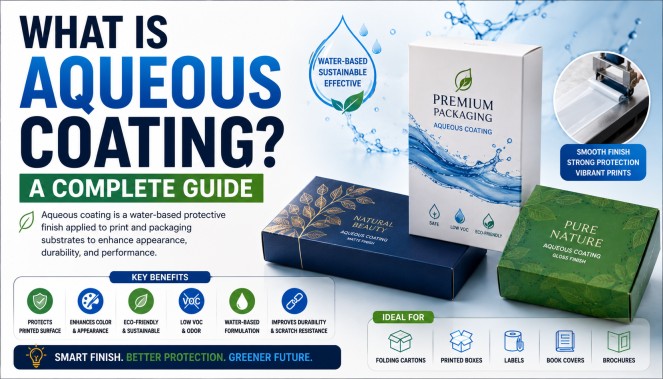
Aqueous coating is an environmentally friendly and transparent protective coating that is used on printed paper and paperboard right after the printing process. In addition to adding beauty to the printed matter, it also protects them from fingerprint marks, scratches, dirt, moisture, and any type of physical damage.
Unlike the solvent based finishes, the aqueous coating does not have any negative impact on the environment since it consists mostly of water along with few volatile organic compounds (VOCs). It has fast drying time and minimum odor, offering a sleek professional look for many different packaging and printed products.
Today, aqueous coating printing technology is extensively used by the packaging industry, publishing industry, advertising industry, and commercial printing industry.
How Does Aqueous Coating Work?
During the printing process, a thin layer of aqueous coating is applied over freshly printed sheets using the printing press’s coating unit.
The coating then passes through hot air and infrared drying systems, allowing the water to evaporate rapidly. Once dried, the coating forms a transparent protective layer that improves durability while enhancing color vibrancy.
Unlike laminated films, aqueous coating becomes part of the printed surface rather than adding a separate plastic layer.
Main Components of Aqueous Coating
Typically, aqueous coating formulations include the following components:
- Water
- Acrylic Polymers
- Protective Resins
- Wax
- Wetting Agents
- Defoamers
- Driers
All these components contribute towards producing a tough film along with maintaining good print clarity.
The Aqueous Coating Process
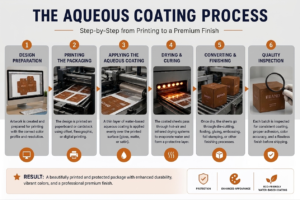
Learning about aqueous coating is useful for businesses to understand why this coating is good for both improving the looks and longevity of printed material. The process itself takes very little time to complete since the coating is done right away in commercial printing. This is the way the process happens:
1. Design Setup
The first stage of the process involves designing your document. It is necessary to prepare a design file that would have a high resolution and be suitable for printing and coating chosen.
2. Printing the Packaging
Artwork is transferred to paperboard or cardstock with the help of offset printing, flexographic printing, or digital printing technology, depending on the nature of the project. Quality ink is utilized for transferring graphics that would be improved further with the help of aqueous coating.
3. Aqueous Coating Application
After printing is finished, a coating unit on the press automatically applies a water-based coating to the printed side. Aqueous coating may be applied in gloss, matte, or satin finish.
4. Drying and Curing
The treated sheets are passed through drying units that have hot air and infrared drying. It allows the water in the coating to dry fast and thus provides an opaque protective coating that is scratch-resistant, smudge-resistant, moisture-resistant, moisture resistant and enhances colors.
5. Converting and Finishing
Once the coating has completely dried, the coated printed sheets are put under other finishing operations like die cutting, folding, binding, embossing, debossing and foiling. Due to fast drying nature and flexibility of aqueous coating, it works well with other finishing operations after printing.
6. Quality Control
Before shipment of the packaging, quality control is done on each batch for consistent coating coverage, adhesion, color accuracy, and perfect finish.
Benefits of Aqueous Coating
Various industries adopt aqueous coating due to several benefits associated with it.
Enhanced Print Protection
Printed packaging goes through the process of transportation, handling, storage, and customer handling. Aqueous coating protects against:
- Scratches
- Smears
- Fingerprint
- Dust
- Small amounts of moisture
- Abrasion of the surface
It ensures that the packaging maintains a high-end look throughout its lifecycle.
Improved Visual Appeal
One of the key reasons for adopting aqueous coating by businesses is because of its ability to improve the print quality.
It makes colors appear:
- Richer
- More vibrant
- Sharper
- Cleaner
Whether using a gloss or matte finish, aqueous coating gives printed packaging a refined, professional appearance.
Fast Drying
The ability of aqueous coating to dry up quickly allows printed products to be quickly transferred to:
- Die Cutting
- Folding
- Gluing
- Packing
- Shipping
Such a feature helps in saving production time.
Environmentally Friendly
Compared to solvent-based coating, aqueous coating is viewed as an environmentally friendly method of finishing.
Its advantages are as follows:
- Low VOC content
- Water base
- No odor
- Recyclable
- Safe environment for workers
Most companies that aim at using environmentally friendly packaging prefer to use aqueous coating.
Cost-Effective
Aqueous coating is a very cost effective solution for many commercial printings.
It is one of the most popular printing finish due to its good quality/price ratio.
Types of Aqueous Coating
Different kinds of aqueous coatings can be chosen based on the desired finish.
Gloss Aqueous Coating
Gloss aqueous coating is a coating process that results in a glossy reflective finish. This makes the colors used in the print look brighter.
Recommended for use on:
- Beauty packaging
- Shopping boxes
- Food packaging
- Catalogs of products
- Promotional material
Matte Aqueous Coating
A matte aqueous coating provides a non-reflective, elegant finish.
Uses include:
- Luxury packaging
- Boxes of premium products
- Corporate brochures
- High-end branding
Satin Aqueous Coating
Satin gives you a coating that lies between gloss and matte.
Satin gives you:
- Moderate sheen
- Smooth surface
- Professional look
- Less glare
Soft Touch Aqueous Coating
There are certain special formulations that give you a soft touch even as it gives you protection.
The applications of soft touch coatings include:
- Luxury gift boxes
- Electronics packaging
- Cosmetics packaging
- Retail items
Common Applications of Aqueous Coating
Because of its versatility, aqueous coating is used across numerous industries.
Popular applications include:
- Custom packaging boxes
- Folding cartons
- Cosmetic boxes
- Pharmaceutical packaging
- Food packaging
- Bakery boxes
- Business cards
- Brochures
- Flyers
- Book covers
- Product catalogs
- Postcards
- Direct mail pieces
- Presentation folders
- Marketing materials
Aqueous Coating vs UV Coating
Although both finishes protect printed materials, they differ significantly.
| Feature | Aqueous Coating | UV Coating |
| Base | Water-based | Ultraviolet-cured |
| Drying | Heat and air drying | UV light curing |
| Environmental Impact | More eco-friendly | Less environmentally friendly |
| Finish | Natural gloss or matte | Very high gloss |
| Cost | More affordable | Higher cost |
| Flexibility | Excellent | Slightly more rigid |
| Food Packaging | Often preferred | Depends on the application |
| Recyclability | Better | Less favorable |
If your priority is sustainability, affordability, and everyday protection, aqueous coating is often the preferred option.
Aqueous Coating vs Varnish
People often confuse varnish with aqueous coating, but they are different finishing methods.
| Feature | Aqueous Coating | Varnish |
| Durability | Higher | Lower |
| Drying Speed | Fast | Slower |
| Protection | Better | Moderate |
| Scratch Resistance | Excellent | Fair |
| Cost | Moderate | Lower |
| Environmental Impact | Better | Depends on formulation |
For premium packaging, aqueous coating generally provides superior protection.
Is Aqueous Coating Safe for Food Packaging?
Yes, many aqueous coatings that conform to FDA standards can be considered appropriate for use in packaging that comes into indirect contact with foods as long as the coating meets regulatory standards.
These coatings are usually used in the manufacture of:
- Bakery boxes
- Pizza boxes
- Snack packages
- Frozen food boxes
- Cereal boxes
- Beverage trays
Does Aqueous Coating Improve Packaging Durability?
The protective coating ensures that the packaging is protected from the following factors:
Scratches
- Fingerprint marks
- Dust accumulation
- Smudges
- Moisture
- Scuff marks during transportation
This proves to be quite important in the case of packaging meant for retail purposes.
Industries That Commonly Use Aqueous Coating
Many different sectors depend on aqueous coating for enhancing the packaging process, such as:
- Food and beverages
- Cosmetics
- Healthcare
- Pharmaceuticals
- Electronics
- Clothing
- Luxury items
- Online shopping
- Retail
- Publishing
- Advertising
How to Choose the Right Aqueous Coating
Factors to Consider for Choosing the Correct Finish Include:
Product Type
Matte finishes work best for luxury goods, whereas glossy finishes are appropriate for retail goods.
Brand Image
The finish you select should match your brand image.
Budget
An aqueous coating gives an ideal balance of cost-effectiveness and performance and thus is best for firms of any size.
Packaging Uses
Products that will undergo more shipping need extra strength, while promotion-related items need more of their look to be emphasized.
Sustainability Goals
Environmental responsibility in packaging is a key consideration when using aqueous coating.
Best Practices for Using Aqueous Coating
For optimum outcomes:
- Choose printing materials that are of high quality.
- Choose the finish depending on the product specifications.
- Do coating tests before full-scale production.
- Collaborate with expert packaging suppliers.
- Ensure compatibility for embossing, foil stamping, etc.
Why Businesses Choose Printed Packaging with Aqueous Coating
In today’s world, packaging must not just be visually appealing but also functional for transportation and marketing at retail stores.
Some key benefits of printed packaging using aqueous coatings include:
- Durable graphics
- Improved customer appearance
- Professional finish
- Cost-effective printing
- Sustainable printing process
- Positive brand perception
This makes it one of the most popular printing processes.
Final Thoughts
The selection of the proper finishing technique plays an important role in determining the quality, look, and even the value of your printed packaging. An aqueous coating is one of the most reliable processes because it gives great print protection, quick processing time, reasonable cost, and environmental safety.
No matter what kind of packaging boxes, cartons, brochures, or other printed materials you want to make, aqueous coating will give you a professional finish and improve both the presentation of the product and the customer experience. The information about aqueous coatings will help you choose the perfect finishing process for your project.
FAQs
1.What is aqueous coating in printing?
Aqueous coating is a water-based protective finish applied over printed materials to improve durability, appearance, and resistance to scratches, fingerprints, and moisture.
2.Is aqueous coating waterproof?
No. While it provides resistance to minor moisture and spills, it is not completely waterproof.
3.Is aqueous coating environmentally friendly?
Yes. Because it is water-based and produces low VOC emissions, aqueous coating is considered a more environmentally responsible finishing option than many solvent-based alternatives.
4.Can aqueous coating be recycled?
Generally, paper products with aqueous coating are easier to recycle than plastic-laminated materials, although recyclability may vary depending on the substrate and local recycling facilities.
5.Which is better: aqueous coating or UV coating?
Neither is universally better. Aqueous coating is ideal for eco-friendly, cost-effective, and flexible packaging, while UV coating is preferred when an ultra-high-gloss finish is required.


 Company
 Top products
 Help
Help
 Payment Method