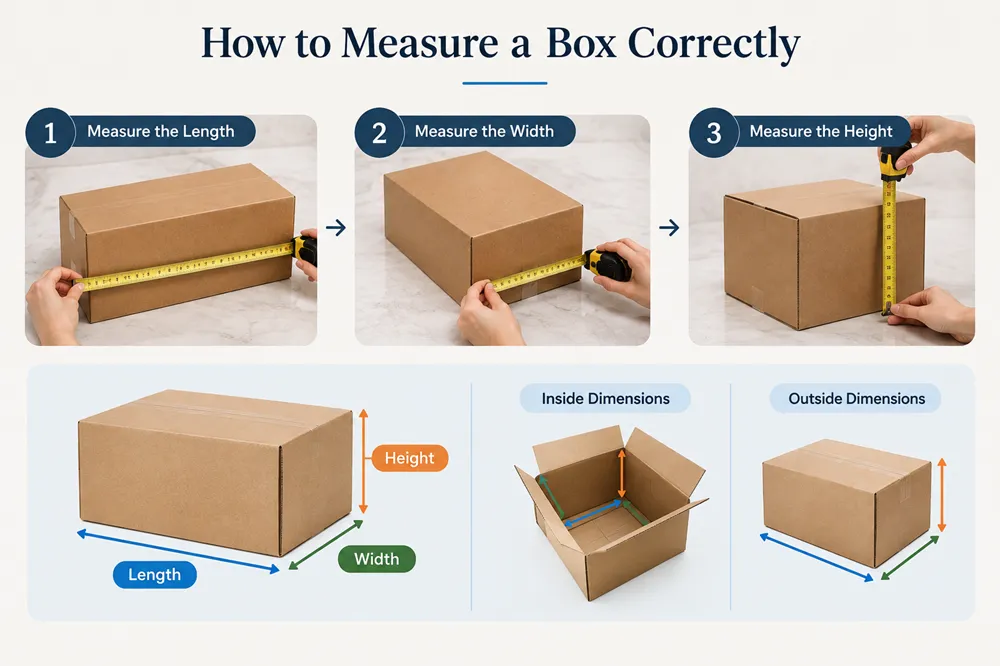
Ordering custom packaging begins with a single, fundamental query: How big should the box be? It is crucial to get the dimensions right because the slightest inaccuracy could affect everything from product fit to shipping costs.
Have you ever found yourself wondering how to measure length, width, and height on a box or which sides represent each dimension? You’re not the only one who has trouble with this.
Measuring a box is easy once you know the order of measurement.
Generally, box dimensions are expressed as:
Length × Width × Height (L × W × H)
This guide explains how to measure a box, whether you are measuring an existing package, preparing dimensions for custom packaging, or checking the size needed for a new product.
What Are the Three Box Dimensions?
Before you get a ruler, learn what each measurement means.
Length
Length refers to the longer side of the horizontal plane on the box.
Width
Width refers to the shorter side of the horizontal plane on the box.
Height
Height refers to the measurement of the vertical plane of the box.
Hence, if a box is 12 inches in length, 8 inches in width, and 4 inches in height, its measurements should read as:
12″ x 8″ x 4″
It’s important to know that the order matters. A box whose measurements are 12 x 8 x 4 should not automatically mean 12 x 4 x 8.
How to Measure a Box
You require a ruler, measuring tape, or any other reliable measuring device to measure a standard rectangular box.
Place the box on a flat surface and determine its three dimensions.
Step 1: Measure the Length
Measure the longest side of the box at its base.
Step 2: Measure the Width
Measure the shorter side of the box at its base.
Step 3: Measure the Height
Measure the height of the box from the bottom to the top.
Note down the three measurements in the same measurement units, such as inches, centimeters, or millimeters.
Example:
Length: 10 inches
Width: 6 inches
Height: 3 inches
The box size is:
10″ × 6″ × 3″
This simple method can work fine with most rectangular product boxes, shipping cartons, retail boxes, and other forms of boxes.
Should You Measure the Inside or Outside of a Box?
This will depend on why you are measuring the dimensions. If it is for packaging purposes, then the inner dimensions of the packaging are usually the most important.
Shipping, storing, and transporting the package may be dependent on its outer dimensions.
The difference is especially important when making custom packaging orders.
Let us consider this example: your product measures:
8″ × 5″ × 2″
This does not mean that the right box size should measure exactly 8″ × 5″ × 2″.
Your box needs some extra room for inserts, protective material, tissue paper, and other packaging supplies.
However, making your package too big may mean that the product can move within the box. The correct packaging should never be “just bigger than the product.”
How Do You Measure the Inside Dimensions of a Box?
Assuming that the box is available and one needs to measure its internal space, the measurements are taken from the interior walls rather than the exterior ones.
Measurement:
Interior length × Interior width × Interior height
As an example:
9.5″ × 6″ × 3″
This measurement gives an approximation of the available space for the product.
In cases where one needs to use internal dimensions for rigid boxes, folding cartons, or any other custom boxes, it is very helpful to make sure the dimensions fit well.
However, in case the product comes with a custom insert, one needs to remember that the insert takes up some space as well. Therefore, the measurement needs to be made of the available space after taking into account the insert.
Why Does Box Size Matter for Custom Packaging?
Dimensions of your package will determine more than just whether the product fits inside. Packaging that is too small may cause undue stress on the product, make it hard to insert into the box, or even damage the package.
Packaging that is too big might lead to unnecessary wasted space, wastefulness of materials used, and improper presentation of the product inside.
Correct packaging dimensions should aim to strike the following balance:
Protection of the product + Presentation + Efficient Use of Material + Practical Shipping
This is especially true in cases of retail packaging, since the box becomes part of the first impression the buyer has of the product.
In the case of a cosmetic box, the package interior must fit the product tightly so as to allow it to stand up. In case of a bakery box, the product needs enough extra space so that frosting or any other decoration does not come in contact with the lid.
How Much Extra Space Should You Leave in a Box?
There is no universally acceptable clearance for all products.
The required space depends on:
- Product shape
- Product size
- Product fragility
- Insert design
- Protective material
- Box construction
- Closing method
- Transportation conditions
- Presentation of the product
For the rigid presentation box with custom insert, the insert is going to firmly hold the product and fill the space around it.
For the shipping box, extra space may be necessary for cushioning.
For the retail product box, on the other hand, too much space could result in unnecessarily large boxes.
Do not just add some arbitrary space; think about the whole packaging concept.
How to Measure Different Types of Boxes
Not every package is a simple rectangular box. Some need slight modification in their measurement techniques.
Mailer Boxes
For mailer boxes, it’s necessary to measure the internal length, width, and height of the box cavity and take into consideration the thickness of the material used and the internal flaps reducing the box cavity.
Rigid Boxes
Measure the interior cavity when determining product fit in a rigid box. For a lid-and-base rigid box, also consider the depth of the lid and the construction of the base.
Folding Cartons
Because folding cartons have panels, flaps, and glued areas, their flat dieline dimensions are different from their finished box dimensions. Always distinguish between the assembled size and the flat layout.
Pillow Boxes
Pillow boxes have curved or folded ends, so the usable interior space may not correspond perfectly to the maximum external dimensions. Measure the actual product cavity when determining fit.
Display Boxes
For display packaging, consider both the internal product space and the external dimensions because shelf presentation may be just as important as product fit.
What Is the Difference Between Box Size and Product Size?
Dimensions of your product and box may not always match.
For instance, let us assume that you have a candle which is:
3” x 3” x 4”
It does not always follow that you will need a box of dimensions: 3” x 3” x 4”
You will have to allow for:
- An insert
- Space for protection
- Tissue paper
- Base structure
- Some decoration
- Covering mechanism
Thus, your box design must take into account all these factors.
Common Mistakes When Measuring a Box
In some cases, a very simple measurement will be inaccurate if it has been measured in the wrong way.
Measure the Wrong Side First
You need to determine which is length and which is width before you make your measurements.
Using Different Units of Measurement
Do not write that you want something of a certain length measured in inches, a certain width in centimeters, and height in millimeters without converting everything.
Measuring Just the Product
Something might fit into the box in theory but not when an insert or any protective material has been included.
Not Accounting for the Box Material
The thickness of the material used to make the box may make a difference between internal and external measurements.
Over-Rounding the Measurement
Sometimes even slight differences in measurement make sense in terms of inserts and fitted products.
Ignoring Other Components
Handles, pumps, lids, corners, and other protruding parts can take up extra room in the package.
Thinking All Suppliers Work by the Same Convention
When ordering custom-made packaging, you have to say what kind of measurements you are providing and whether they are internal or external.
Why Accurate Measurements Matter for Custom Boxes
Correct measurements can help save time, effort, and material costs, as well as prevent extra work. A properly fitting box could contribute to better product protection and enhance the quality of presentation. Moreover, it may help prevent any complications at the production stage, particularly if custom inserts, closures, windows, or other structural components are required.
In case of large quantities of packaging ordered by brands, precise measurements before production are even more crucial. An insignificant mistake in measuring may result in considerable losses.
This is the reason why measurement is a key step that cannot be underestimated. It is the basis of the packaging design.
Need Custom Boxes in the Right Size?
Having accurate measurements is the starting point for designing packaging that will suit your product in terms of both protection and presentation. At Packaging Heights, it is possible to design custom packages in accordance with the exact measurements of your product. Whether it is a retail box, a product package, display packaging, or a particular box style you want, accurate measurements will make sure that the final product will function correctly.
Have your product dimensions ready? Get in touch with Packaging Heights to discuss the right box size and custom packaging solution for your product.
FAQs
1. What is the correct order for box dimensions?
The measurement of the box is always represented as L x W x H (Length × Width × Height).
2. How do I measure a box for a product?
First, you have to measure the dimensions of the product and take into consideration the inserts, protective material, etc.
3. Should I measure the inside or outside of a box?
Usually, the interior dimensions would matter more for product fit; the exterior dimensions would be more useful for shipping and transportation purposes.
4. Can I use product dimensions as my box dimensions?
Not always. The box might require extra space for inserts, closures, and other packaging components.
5. What tools do I need to measure a box?
Most likely, you only need a ruler or measuring tape for standard boxes. In case of high-accuracy custom packaging, it would be better to measure in inches or millimeters.




 Company
 Top products
 Help
Help
 Payment Method