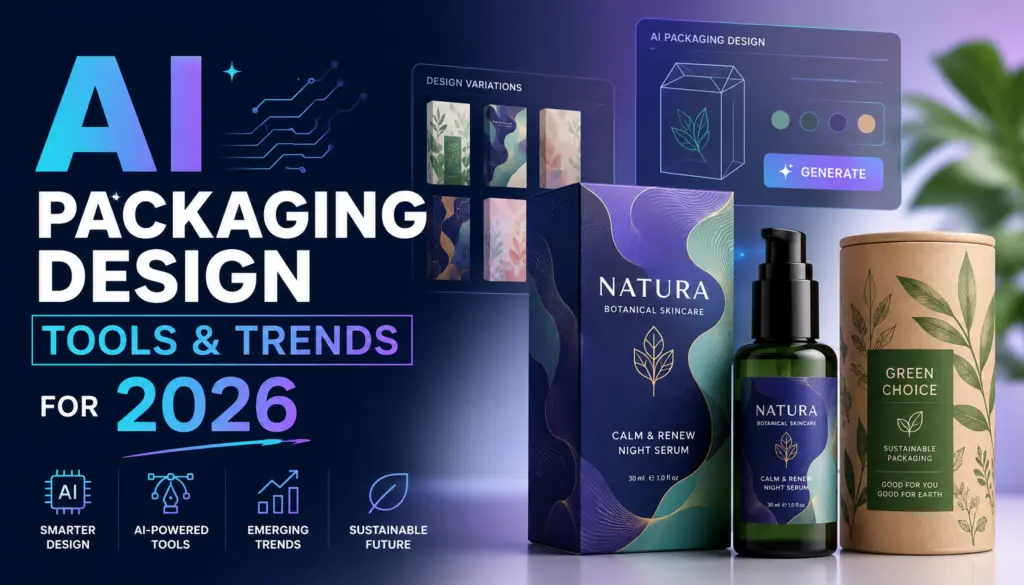
We have entered a new era in the world of packaging. Designing processes that would have taken many days of contemplation and trial-and-error experiments are now possible within a couple of hours with AI packaging design software.
In 2026, businesses are not only designing packaging but also optimizing it with the assistance of data, automation, and AI packaging design technology. Whatever your need for designing packaging designs or 3D box mockups, you would realize that AI packaging design has made all the difference in the process.
If you are still relying only on traditional methods of packaging design, you are behind the times.
This guide is going to talk about everything, starting from AI packaging design technology, trends, and ways to utilize them.
What Is AI Packaging Design?
AI packaging design involves the employment of artificial intelligence to design packages in a more automated and optimized way.
AI helps you to:
- Develop several designs for packaging immediately
- Develop realistic 3D mock-ups of the packaging designs
- Optimize the box dimensions and materials used in the process
- Ensure consistency in brand packaging design
The adoption of AI in packaging design has increased because of its efficiency and effectiveness.
Why AI Is Transforming Packaging in 2026
AI is not only about design, but it’s also becoming a competitive edge.
1. Time-saving and Effective
It will be able to generate several designs for your package within seconds, rather than wasting days on this process.
2. Cost Reduction
The automated process will lower expenses and save material.
3. Smart Decisions
By analyzing consumer behavior, you can design effective packaging.
4. Scalability
Regardless of whether you have 5 or 500 products, you’ll always maintain consistency with your branding with the help of AI packaging solutions.
Top AI Packaging Design Tools in 2026
Though AI hasn’t replaced the role of packaging designers, it is revolutionizing the process of designing by assisting designers in the creation, development, and refinement of the designs. Here are some of the most frequently used software applications for packaging design through artificial intelligence.
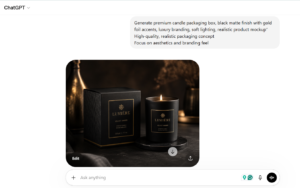
1. GPT-4 Image Generation (Concept Development & Creative Exploration)
With GPT-4 Image Generation software applications, it has become easier than ever to develop packaging designs from scratch. By using textual information, the brands can come up with packaging designs quickly.
Use Cases:
- Generation of packaging designs using text inputs
- Testing out different design styles quickly
- Creation of inspiration boards and other inspirational resources
Limitation:
Generated output designs may require refinement before they can be applied in any design work.
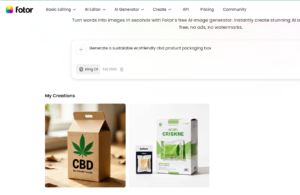
2. Fotor (AI-Based Visual Enhancement & Design Support)
Fotor is usually used for developing the look of package designs, especially in terms of image, texture, and presentation improvements.
It can serve as an intermediary stage between an initial concept and its visualization.
Use cases:
- Improvement of packaging designs’ mockups
- Modification of colors and textures
- Presentation of high-quality visual content
Limitations:
Fotor is oriented more towards visualization than packaging construction.
3. Packify (Structural Packaging & Box Design Automation)
Packify is all about technical side of packaging – more precisely, packaging structure and box dimensions.
The application enables users to design box structures and dielines with precision, thus proving highly beneficial for companies that need to prepare packaging for manufacture.
Primary use cases:
- Box structure and dieline creation
- Fine-tuning box dimensions
- Packaging for production
Limitation:
It is relatively technical in nature.
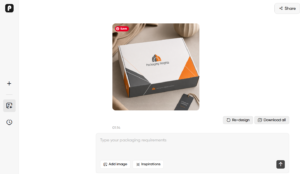
4. Adobe Firefly (Advanced AI for Professional Packaging Design)
Firefly by Adobe is designed for creators who want to combine creativity and accuracy. This tool allows AI-generated images to be incorporated within the professional workflow of designing.
Using Adobe Firefly, users will be able to develop textures, patterns, and visuals associated with brand identity.
Use cases include:
- Generating quality design assets
- Ensuring brand uniformity
- Producing visuals ready for production
Limitation:
It is best used by people familiar with Adobe products.
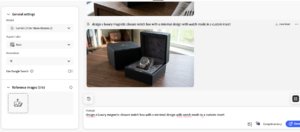
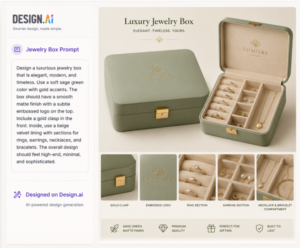
5. Designs.ai (AI-Driven Branding and Packaging Integration)
The tool designs.ai unifies branding and packaging design in one platform, hence making it ideal for startups and growing firms.
This makes it possible to create logos, colors, and packages that are aligned with each other.
Use cases:
- Branding and packaging design creation
- Consistent design asset generation
- Faster launch of products
Limitation:
Limited customization ability than some of the complex design platforms.
How to Use AI for Packaging Design
For beginners who do not have experience working on packaging designs using AI technology, it may seem like too much initially. However, the best thing is that you will not have to do all the steps simultaneously.
In most cases, the process starts with inspiration and ends with the creation of actual designs ready for packaging.
Here’s what the basic sequence looks like:
Step 1: Start with Ideas and Visual Direction
Before you start designing your packaging concept, you will require a solid direction.
To come up with one, you may use AI image generators like Canva and GPT-4.
This is basically an idea-generating process when you ask yourself:
- How should the packaging look?
- Will it be minimalist, bold, premium, or playful?
Step 2: Turn Your Branding Into the Design
With tools such as Designs.ai and Adobe Firefly, you can include:
- Color scheme
- Typography
- Logo positioning
All of which will ensure that your brand identity matches.
Step 3: Bring Your Design to Life with Box Mockups
Here comes the part where you get to see what your packaging would look like in reality.
Using software such as Packify, you can:
- Build box designs
- Create box dielines
- View packaging in 3D
Step 4: Modify the Dimensions of the Box
After building your structure, make some adjustments to the dimensions of your box:
- Making sure that the product will fit
- Ensuring enough room for any protective material
- No extra space
Tools like AI calculators can assist you in achieving this.
Step 5: Preparing Files for Production
It is now time for your project to be prepared for manufacturing.
In this final step, you will:
- Create print-ready files
- Change your colors to CMYK format
- Perfect your dielines and layout alignment
It will guarantee that your digital design matches its printed version.
Tip for You (Based on Real Experience)
Always remember to test your packaging even when using AI software for assistance. A test run will allow you to spot any problems with sizing/design early on.
Limitations of AI in Packaging
The integration of AI into packaging doesn’t make it flawless.
- Most applications work wonders in generating concepts but require manual optimization.
- The structural aspect of packaging still demands human input.
- Files may require adjustments before printing.
Even in the future, the winning combination will remain AI-assisted human knowledge.
Why Businesses Are Rapidly Adopting AI Packaging
Using AI packaging design tools provides:
- Quicker time-to-market
- Reduced the cost of design
- Improved customer interaction
- Greater brand uniformity
Conclusion: Where AI Meets Real Packaging Expertise
AI has revolutionized the field of packaging design – but technology alone is insufficient.
It will assist you in brainstorming, automation of procedures, and acceleration of work processes, but making these AI outputs usable for the purpose of making an efficient packaging solution requires expertise and experience.
In the year 2026, companies that are going to make it big are those that not only will use AI but also combine AI with professional execution.
They will use AI for discovering design opportunities, but they will seek the help of professionals for ensuring that the package has the right structure, right size, right materials, and right efficiencies in terms of practical usage.
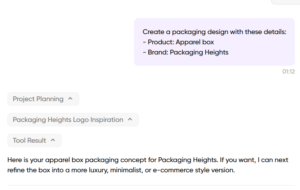
Here comes Packaging Heights into the picture.
By combining AI-based designs with the expertise of packaging experts, we enable organizations to take their packaging game one step ahead of others and come up with innovative, efficient, and effective packaging solutions.


 Company
 Top products
 Help
Help
 Payment Method