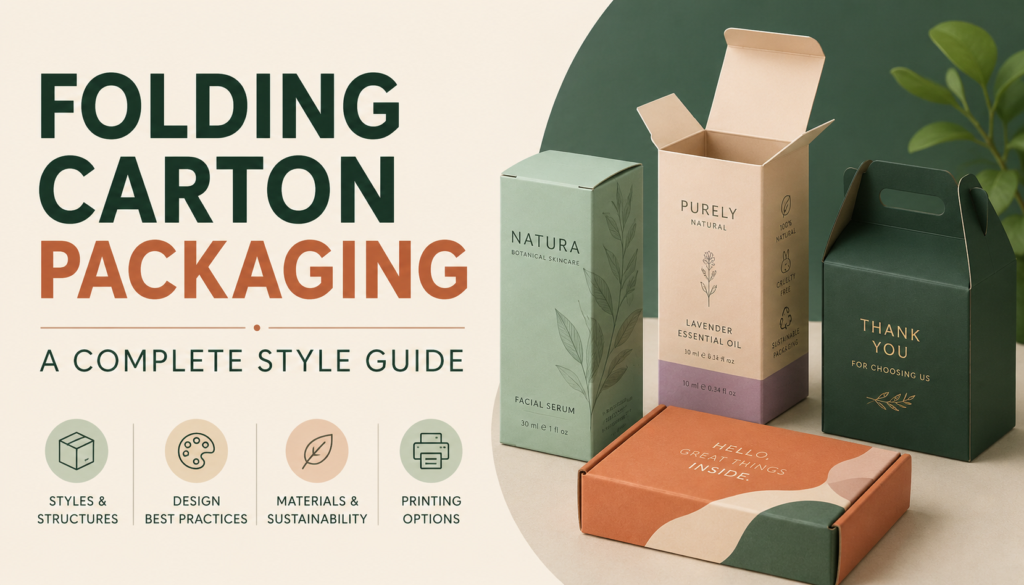
Nowadays, packaging is not only a means of protection but also a kind of silent seller. There are numerous choices when it comes to packaging in business, but Folding Carton Packaging is among the best choices available that not only help in saving money for businesses but also offer flexibility and make an impressive impression on customers.
Which products use folding cartons for packaging? Why do manufacturers prefer folding cartons? What are the types and advantages of folding cartons?
This guide will tell you everything you should know about folding cartons, including its types, benefits, materials, applications, and more.
What is Folding Carton Packaging?
Folding Carton Packaging refers to the kind of packaging that utilizes paperboard to manufacture boxes through various processes, such as printing, cutting, folding, and gluing. The packing material can be delivered flat and folded into a box only during times of necessity. This makes it an effective packaging solution.
They find extensive applications in retail-ready packaging due to their cost-effectiveness and effective branding capabilities.
Popular materials are:
- SBS (Solid Bleached Sulfate)
- CCNB (Clay Coated News Back)
- Recycled Paperboard
Why Folding Cartons Are So Popular
The reason behind the success of custom folding cartons is quite logical and practical, but there is much more.
1. Economical Production
Compared to rigid boxes, folding boxes cost less to manufacture, especially in bulk.
2. Lighter and Space-Saving
Since they are shipped flat, like collapsible boxes, they save on shipping and storage expenses.
3. Higher Level of Customization
Businesses have complete freedom when it comes to:
- The structure of boxes
- Printing techniques used
- The finish (matte, glossy, soft touch)
- The possibilities include embossing and foil stamping, among other things.
Thus, one can create branded folded carton packaging that fits the brand’s identity perfectly.
4. Eco-Friendly Packaging
The customers today look for sustainable choices, and selecting folding boxes that are recycled is an environmentally friendly decision for your business.
Types of Folding Carton Styles
Different products require different carton styles. Here are the most commonly used structures:
Tuck End Box Styles
The Tuck End Box style, often referred to as tuck top boxes, is one of the most commonly employed types of folding carton packaging because of its easy assembly process, low cost, and adaptability. The Tuck End Box style is well-suited for products that are light or moderately heavy and can be used in different retail sectors.
Common variations include:
Straight Tuck End (STE)
The top and bottom flaps tuck in one direction. This style is recommended for those who need a neat-looking front face and can be used for cosmetic boxes, skincare items, and other retail products.
Reverse Tuck End (RTE)
The top and bottom flaps tuck in opposite directions. This design is one of the cheapest custom boxes to manufacture and is widely used for pharmaceuticals, electronics, and light products.
Tuck Top Auto Bottom (TTAB)
This design has both a tuck-top and an auto-lock bottom, which makes the box stronger. This design is recommended for use when you need more strength for your products but want to keep assembly easy.
Tuck Top Snap Lock Bottom
It works just like an auto bottom but requires assembly. This style is durable and used in retail folding cartons for jars, bottles, and heavy cosmetics.
Roll End Tuck Top
This box style has dust flaps and a roll-over closure for better protection. Used to pack food items and subscriptions.
Bottom Closure Box Styles
Bottom Closure Boxes are especially designed to carry heavier goods through additional base support. These cartons play an important role in industries that require the use of heavy products, such as the food industry, the beverages industry, and heavy industrial items.
Some common bottom closure carton types include:
Auto Lock Bottom Carton (Crash Bottom Carton):
Pre-glued at the base, this carton closes automatically once opened. It is considered to be highly effective in folding carton packaging because of its efficiency in fast-moving packaging machines.
Snap Lock Bottom Carton (1-2-3 Bottom Carton):
Involves folding and locking of flaps manually; although not very efficient, it offers sufficient support for medium-sized goods.
Seal End Carton:
Both ends are sealed, usually glued for tamper-proofing. Mostly used for pharmaceutical folding cartons and food packaging cartons.
Full Overlap (FOL) Bottom Carton:
Overlapping of bottom flaps, offering high structural stability for heavy and bulky goods.
Two Piece Box Styles
Two-piece boxes feature a box lid and base, ensuring high-quality unboxing experiences. These are generally adopted when luxury folding carton packaging is to be considered because they provide better presentation.
Main types include:
Full Telescope Box:
This type has a lid that completely covers the base, ensuring maximum security. This is ideal for packaging electronics and gifts.
Partial Telescope Box:
This type has a lid partially covering the base, making it easy to remove the contents while also providing adequate security. Perfect for display packaging.
Tray & Lid Box:
This simple and stylish design is common in packaging foods such as bakery products, chocolates, and takeout meals.
Shoulder Neck Box:
This type comes with an inner shoulder, which holds the lid together. It is commonly used for packaging cosmetics and jewelry.
Specialty Packaging Styles
Specialty packaging refers to non-traditional packaging styles created through innovations in structure to improve packaging functionality.
Some common specialty packaging styles are:
Window Patch Boxes:
Come with a window that enables shoppers to view the package’s contents. Common in food and retail cartons.
Sleeve Packaging (Slipcase):
An outer sleeve that slips onto the main box/tray. Used in high-end folding carton packaging.
Display Boxes:
Display boxes can be used both as packaging and display cases for the products. Suitable for custom retail display packaging.
Gable Boxes:
Contain a built-in handle and have a unique box lid for closing purposes. Often used in takeaway food packaging and gift packaging.
Pillow Boxes:
Have a curved design with tucks at the side. Best suited for light products such as accessories, giveaways, etc.
Die-Cut Custom Shapes:
Custom shapes are designed according to the branding and packaging needs of the business.
Industries That Rely on Folding Cartons
Folding cartons’ versatility has made them an essential part of many industries, including:
Cosmetics & Personal Care
Aesthetic designs and printing is used for fragrance packs, moisturizer containers, and other personal care items. Features such as foil blocking and embossing are used to enhance these cartons further.
Food & Beverages
Boxes for cereals, beverages, and even frozen foods are made from folding cartons due to their hygienic and protective nature.
Pharmaceuticals
Exactness and clarity are of utmost importance in these cartons. Dosing details, barcodes, tamper proof features are among the common features found in pharmaceutical folding cartons.
Electronics
For mini electronics, accessories, and electronic components, strong cartons with protective inserts must be used.
Retail & E-commerce
Printed folding cartons are generally used by retailers for their packaging requirements.
Materials Used in Folding Carton Packaging
Materials are very important in ensuring longevity, visual appeal, and sustainability.
SBS Board (Premium Choice)
This material is recommended for use in premium packaging because of its smoothness and excellent printability.
CCNB Board (Cost-Effective)
It is made from recycled paper, making it an appropriate choice for economical packaging.
Kraft Paperboard
Folding carton packaging made of this type of paperboard looks natural and sustainable.
Laminated Boards
These boards are selected where moisture protection is necessary.
Printing & Finishing Options
One of the key benefits of using folding cartons is the possibility to improve their appearance by means of printing.
Print Techniques:
- Offset printing
- Digital printing
- Flexography
Finishing Techniques:
- Matte or glossy lamination
- UV coating
- Stamping
- Embossing
- Debossing
For instance, a skincare company may choose soft touch matte finish and gold foil printing to emphasize luxury and reliability.
It is those features that allow turning ordinary packaging into high-quality folding carton packaging products.
Sustainability in Folding Carton Packaging
Consumers in today’s world like those brands that employ:
- Recyclable material
- Inks made from soy
- Limited plastic
- Biodegradable coating
Sustainable folding cartons as packaging solutions help brands enhance their positioning in the consumer market.
Common Design Mistakes to Avoid
An amazing product can become mediocre due to the ineffective design of its packaging. Below are some things that must be avoided at all costs:
- Too many graphics that might confuse the consumer.
- The choice of an unprofessional font.
- Inadequate strength of the package design.
- Brand identity inconsistency.
- Low-quality materials for high-end products.
A good packaging design must be attractive and clear.
Final Thoughts
Folding Carton Packaging goes way beyond just being another box; it is a branding device that can influence customer perception before the box is even opened. Thanks to its versatility, advanced printing technology, and eco-friendly composition, Folding Carton Packaging is everything today’s brands need to be successful.
As a company specializing in custom packaging solutions for businesses, Packaging Heights recognizes the true value of proper packaging – communication, confidence, and an unforgettable experience.
In case your business requires a reliable yet attractive custom carton solution, high-quality folding cartons might become a key element of successful promotion.
After all, a great box creates a lasting impression and adds value to a product.





 Company
 Top products
 Help
Help
 Payment Method